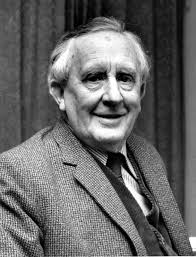
Since I am currently reading The Lord of the Rings (just started book two of The Two Towers) I wanted to focus on Tolkien for this week’s blog. I have been rather negligent of my other blogs since most of my time is spent working full-time and writing my newest novel, The Lady of Steam and Shadow, 14 chapters so far are available to read on patreon.com/storytimebyrk
Here we go:
Few writers have shaped modern literature as profoundly as J. R. R. Tolkien. A scholar, linguist, and storyteller of rare depth, Tolkien did not merely write fantasy—he constructed an entire mythological universe, complete with languages, histories, and cultures that continue to influence writers, designers, and artists today. Truly an amazing accomplishment for any writer.
A Life Rooted in Language and Loss
John Ronald Reuel Tolkien was born on January 3, 1892, in Bloemfontein, then part of the British Empire. His early life was marked by upheaval. After the death of his father, Tolkien returned with his mother to England, where he would spend the rest of his life.
Tragedy struck again when his mother died in 1904, leaving Tolkien and his brother under the guardianship of Father Francis Morgan. This early confrontation with grief, displacement, and faith would later echo in his writing—particularly in themes of loss, endurance, and quiet heroism.
Tolkien attended King Edward’s School and later Exeter College, Oxford, where he studied classics and philology. His academic work focused on Old English, Norse, and Germanic languages—disciplines that would become the backbone of his literary creations.
War, Fellowship, and the Seeds of Middle-earth
Tolkien served in the British Army during World War I, enduring the horrors of the Battle of the Somme. Many of his closest friends were lost in the war, a trauma that profoundly shaped his worldview.
Out of this darkness, Tolkien began to write the earliest myths of what would become Middle-earth. These stories were not initially intended for publication but were part of a lifelong project to create a mythology for England.
Scholar by Day, Mythmaker by Night
After the war, Tolkien became a professor at University of Oxford, specializing in Anglo-Saxon and English language studies. His lecture on Beowulf remains one of the most influential academic interpretations of the text.
But it was in his private writing that Tolkien’s imagination flourished. He developed entire languages—such as Quenya and Sindarin—before crafting the stories that would justify their existence.
The Birth of Middle-earth
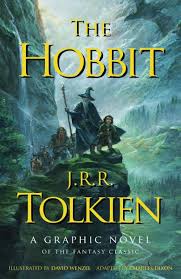
Tolkien’s literary breakthrough came with the publication of The Hobbit in 1937, a charming yet layered tale that introduced readers to hobbits, dwarves, and the wider world beyond.
Its success led to his magnum opus, The Lord of the Rings (1954–1955), a monumental work that redefined the fantasy genre. Unlike anything before it, the trilogy combined epic narrative with linguistic precision and mythological depth.
Central themes include:
- The corrupting nature of power
- The resilience of the humble
- The fading of ancient worlds
- Friendship and sacrifice
Faith, Friendship, and Influence
Tolkien was a devout Catholic, and while his works are not overtly allegorical, his moral philosophy subtly permeates the narrative. His close friendship with C. S. Lewis, author of The Chronicles of Narnia, played a significant role in encouraging him to publish his work.
Together, they were part of the Inklings, an informal literary group that met in Oxford to discuss and critique one another’s writing.
A Legacy That Endures
Tolkien passed away on September 2, 1973, but his influence has only grown. His works have inspired:
- Modern fantasy literature
- Film adaptations by Peter Jackson
- Video games, art, and academic study
The world of Middle-earth remains one of the most detailed fictional universes ever created.
Tolkien’s Books in Chronological Order
Below is a structured list of Tolkien’s major works, arranged by publication date:
Early and Foundational Works
- The Hobbit (1937)
The Lord of the Rings Trilogy
- The Fellowship of the Ring (1954)
- The Two Towers (1954)
- The Return of the King (1955)
Posthumous Publications (Edited by Christopher Tolkien)
- The Adventures of Tom Bombadil (1962)
- Smith of Wootton Major (1967)
After Tolkien’s death:
- The Silmarillion
- Unfinished Tales
- The History of Middle-earth (1983–1996)
- The Children of Húrin
- Beren and Lúthien
- The Fall of Gondolin
Why Tolkien Still Matters
Tolkien’s genius lies not just in storytelling, but in world-building as an art form. His work bridges literature, linguistics, mythology, and design—making him as relevant to interior designers, artists, and writers as he is to literary scholars.
His influence can be seen in everything from medieval-inspired interiors to narrative-driven design concepts that prioritize atmosphere and story.




One comment on “J.R.R. Tolkien: Architect of Middle-earth and Master of Myth”